

Read a mother’s first-hand account on discovering that her unborn daughter had talipes (clubfoot) and the journey that her family took to understand it.
When I was told at my 20 week scan that it looked like my baby had talipes, I didn’t really think much of it.
The sonographer said it could just be the position of the baby’s foot in the womb and to have another scan to be sure. My husband, Paul, then mentioned that he had club foot as a baby and had to wear a boot for 6 months to correct it, so I thought it was no big deal.

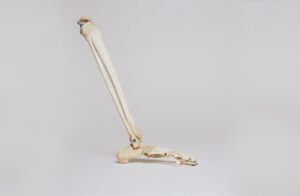
Talipes is more commonly known as Clubfoot. It is where one or both feet aren’t straight and are structured at an angle. It affects 1 to 2 babies in every thousand. It’s hereditary and more common in boys.
We had another scan to check and it was confirmed the baby had talipes. I was told by the sonographer, not to google it as there’s varying degrees of severity and it could just be positional and not structural, in which case the baby would only need a bit of physiotherapy on it’s foot which we could do at home. Again, I thought it was no big deal, took her advice and didn’t google it, naïve in what was to come.
A letter arrived inviting me to an appointment with a physiotherapist to talk through the talipes. I went along thinking it would be to show me how to do the physiotherapy when the baby arrived. How wrong could I have been?
Myself and another mum-to-be who was also expecting a baby with talipes, met a physiotherapist at Maidstone hospital. I was totally unprepared for what I was about to be told. She gave us leaflets and talked us through the treatment that our babies would inevitably have to go through. There were pictures of babies with ugly looking boots on their feet with a bar attaching them so they couldn’t move their feet independently of each other. I’d never seen this before and was shocked at the severity of the treatment. We were told that the babies would have to be in casts when they were just 2 weeks old, for 6 weeks and then they’d have to have a tenotomy where the tendon in the affected foot would be cut to stretch the foot in the correct place. The babies would then need the boots and bar for 12 weeks, 23 hours a day, and then every night for 12-14 hours until they were 5. I couldn’t believe what I was hearing and felt very teary. The other mum-to-be seemed well prepared, had questions ready and seemed calmer than I felt. It made me feel so stupid that I’d listened to the sonographer and hadn’t done any research on it myself. Because I was so unprepared, I felt like I must have come across that I didn’t care enough and that really upset me.
The physiotherapist also told us about a facebook support page and said it would be helpful to have a read to see what the parents and babies went through. I joined the group straight away and was even more devastated reading some of the comments from parents about their babies having sores on their feet, and sleepless nights when they go into boots and bar.
I came home and cried. My husband felt guilty that he should have been there with me, but neither of us thought it was as serious as it was. We’d had so many problems with our eldest, Matilda, when she was born with reflux, I couldn’t enjoy my maternity leave at all because she screamed constantly. I just wanted this time to be easier and to enjoy my time off with my babies. It sounded like I’ll be spending the majority of my maternity leave back at constant hospital appointments. I felt that why did my baby have it when everyone else’s babies were normal, and they could just enjoy them? Selfish I know but that’s how I felt at first and I felt bad feeling it because I’ve known mums to go through much worse, so I had to keep reminding myself of that.
We had another appointment with the sonographer I saw previously, and I told her about the meeting. She was appalled and still insisted that we couldn’t be sure of the treatment until the baby was born.
On 16th November 2018, Eliza Polly was born by caesarean section at Pembury hospital, Tunbridge Wells. The first thing I was told as I was lying on the table being stitched back up was that, yes, her foot was bad. That day I didn’t take much notice of it, I just enjoyed the moment of having a new baby and focussed on her feeding and sleeping.

The following day the physiotherapists came up to examine Eliza’s foot. She had unilateral talipes in her left foot. This was a blessing as there are a number of babies with bilateral talipes, which means that both feet are affected. I found this examination very distressing. They were pulling her feet this way and that way and being what I felt was really rough to a newborn. Eliza was screaming so loud and got so red in the face, I felt completely helpless just lying on the bed watching. What I found throughout the process is that all the professionals say that whatever they’re doing isn’t hurting the baby, but all I could think was how do they know that? It didn’t look or feel like it didn’t hurt Eliza. Anyway, they did what they needed to do and then said we will have an appointment at the Ponsetti clinic in the next few weeks. We took Eliza home, left foot poking through her little onesies and tried to appreciate every moment that her foot would be free.
2 weeks later we returned to Pembury to the Ponsetti clinic. I’ve got to admit this was probably one of the worst days of my life emotionally. We met the team, who were all very nice, we were talked through the process again and asked if it was ok if they put the first cast on there and then of which we agreed. We were taken to a room, Eliza was put on the bed and we had to strip her waist down. After more manoeuvring of her foot, of which Eliza started screaming, one of the physiotherapists put on her cast. It took some time because of her distress and again the professionals told us that it wasn’t hurting her. We tried feeding her to calm her, which is the recommended method, but it wasn’t working so they just had to get on with it. I was sitting on a chair next to her and seeing her so distressed, whether she was in pain or not, made me very emotional. I felt so embarrassed to cry in front of the team I tried to hide my tears behind my hair. I couldn’t stop crying the whole way home and for most of the evening. I felt completely drained and so sorry for my little girl. She felt so heavy to lift I’m sure it must have been very uncomfortable for her.
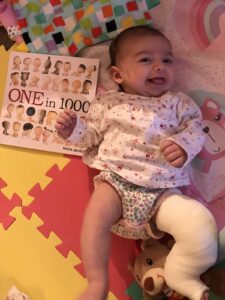
2 days later we noticed that her cast had slipped down and was hiding her little toe, so I had to take her to Maidstone Hospital for a re-casting. This was the first time I had to have her cast cut. We had been warned by the team and other mums to be prepared for the cutting as it seems worse than it is. Again, we were told that it doesn’t hurt the baby. As I was prepared for this it didn’t feel so bad and it didn’t seem to bother Eliza, the loud humming noise that it makes actually soothed her which made me feel relieved. We had the cast re-done and that was that until the following week, where her cast was removed again, she had her weekly bath and then her foot was repositioned before the next cast was put on. As the casts were changed weekly, babies are bathed on their cast change day at the hospital before the new cast is put on. It’s more of an annoyance than anything. The most annoying being that while changing a nappy, if the babies poo gets on the top of the cast, you can only try to clean it with a wipe. As a talipes parent, you find out these things along the way and find ways to overcome them. The casting process continued every week for 6 weeks until 3rd January.
I dreaded the tenotomy and was given so much hope previously that her feet were doing so well that she was unlikely to need one (the majority of talipes babies do need a tenotomy). When we were told just before Christmas that she would need one my heart sank, but I tried to just brush it off and get on with it. 3rd January came, and we arrived at the hospital at 7am to the children’s ward. Her last feed was at 2am that morning and she wouldn’t be able to have any more milk until after the procedure. Paul dropped me off at the hospital and went on to drop our 3 year old to nursery before coming back. I thought they would rush us in considering Eliza was only 7 weeks old and would need to be fed. I was pleased we had the morning slot but was surprised how long it took for them to take her down. She started to get really hungry and screamed the ward down. There was nothing we could do. Again, I felt helpless. At about 10am they came to take her down. We went down to the basement where the surgery rooms were. Only one of us could then go on with her and I asked Paul if he could do it because it would be easier for me to hand her over to Paul in the waiting area, than handing her over to a surgeon and walking away. We went back up to her room to wait. We were told that the procedure would only take 45 minutes, however the time went on and on and once we past the hour mark I started to worry that something had gone wrong. Paul went to the reception of the children’s ward while I waited in her room thinking they would bring her back any minute. As time went on I needed a distraction so went to wait with Paul. The one thing I’ll never forget about that day is seeing a little girl, 2 or 3 years old, with sporadic hair and tubes up her nose, happily playing in the waiting area. My heart broke for that girl and her parents, who seemed so in control and brave. I cried while I sat there waiting for Eliza to return, but not for Eliza, for this happy little girl who was going through so much at such a young age. It really put Eliza’s treatment into perspective and I’ll always remember that. While I was crying the lady from Ponsetti clinic came to me to read and sign some paperwork, the same lady who saw me cry at Eliza’s first casting. This made me really embarrassed because I didn’t want her to think I was crying over something small like a tenotomy, when there was that little girl going through cancer treatment!
It wasn’t long for Eliza to come back up where we fed her and were soon able to bring her home. She seemed absolutely fine, we just gave her lots of cuddles that day.
She was back in a cast and this one had to be on for 2 weeks. 2 weeks without a bath!! Poor smelly Eliza! We got through this and then she had her boots and bar. For every stage it felt like it was less dramatic than the last and just part of the process. We got to know the team really well and just reminded ourselves that this was all for Eliza’s benefit so she would be able to walk and be as active as any other child.
Eliza’s first night in boots and bar was one of the worst nights since Eliza was born, she was so unsettled, I slept downstairs on the sofa with her beside me in her carrycot. We both got about half an hours sleep the whole night, I spent most of it cuddling and singing to her to try to soothe her but nothing would work. In the morning when I removed her boots to change her, I noticed how tight they were. The previous night after her daily hour off splashing in the bath, I was so concerned about getting the boots on correctly so the treatment would go well, that I put them on too tight, it was me that had caused her discomfort during the night and I felt awful. Luckily we got over this and she settled in them fine. We found that unlike the cast which made nappy changing a struggle, the boots and bar had a benefit! We could lift the bar to change her and she wasn’t able to kick her feet around in the mess she made. This really made myself and Paul laugh! Small mercies!!!!
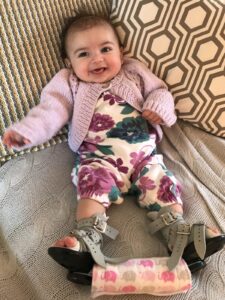
The worst part of the full-time boots and bar stage was the fact that people stared. We were lucky that it was winter and Eliza was mostly hidden when we were out in her buggy with a blanket. I can imagine how hard it must be for summer babies, to have to wear casts when it’s hot and then have the boots and bar on show. The last few weeks of Eliza’s full-time wear I noticed more and more staring as she was getting older and slept less, when we were out she was out of her buggy more and more. On Easter Saturday we took our 3 year old to Ightham Mote for an Easter Egg hunt and as it’s not suitable for buggies, I had Eliza in a sling, with her boots on show. I can understand stares, it’s something you don’t often see, and people must wonder what they’re for, but what I didn’t understand is why people would give such evil stares. Some were curious, but the evil ones were so upsetting. If someone was curious and stared and then noticed that I’d seen them, I’d expect them to smile at me, instead some people just glanced in disgust. I found this so unbelievable, as if I’d done something to hurt my baby. It made me feel so protective over Eliza, I cuddled her closer and couldn’t stop kissing the top of her head. It’s times like this where the facebook support page was such a help. I instantly posted my experience on the page and had so much positive response. One lady had said that when she took her eldest child to school, one mum who saw her baby in a cast reported her to social services. There really needs to be more awareness of talipes for people to understand that it’s a medical condition and not something the parents have inflicted on their child! Luckily after this incident, we only had 3 weeks left in full-time boots and bar. On 18th April, I took Eliza back to Pembury where I was told that her foot was looking great and that she could move to part-time boots and bar. It was the first sunny day of the year! I took Eliza back home, sat her in the garden and she kicked around all afternoon and stood with her feet in the grass. It was a very special afternoon.
Now it’s 4 ½ years of part-time wear for 12-14 hours during the night and nap times during the day. I’m sure we’ll have our struggles during the toddler years and we’ve still got a lot to get through, but I feel that the worst is over.
On the whole, it all sounds like it’s a pretty harrowing experience but looking back you just get through it stage by stage, and it’s such a short period all to make Eliza’s development normal in the future. What I’ve taken from the experience so far is that we are lucky it wasn’t anything serious and there are so many other conditions out there which aren’t treat-able, and parents and children have to live with whatever condition for life and struggle through and learn to deal with the glances and stares. We are very lucky. Thank you to the Ponsetti team at Maidstone and Pembury, Eliza is one lucky girl to be under your care.